Reprinted from NJSpotlight. July 9, 2024. Written by Taylor Jung, Social Justice Writer
Harm reduction: In Paterson, a world of assistance in one small building. A lifeline to social services — and personal connections — for people with substance use issues
Potential for change
Harm reduction refers to programs and policies that help reduce negative consequences for people who use substances.
- The goal is to save lives – not force detox or abstinence unless the person wants help.
- Harm reduction includes teaching safe substance use and safe sex practices and helping connect people to social services.
- Drug policy experts say harm reduction helps reduce substance-related deaths.
It’s a cold and blustery March day in Paterson, with mist saturating the air. The usual steady bustle of traffic and pedestrians on Broadway is absent.
That is, all except for one building across from the city’s columned public library, where there is a constant flow of people entering and exiting. The black awning reads Black Lives Matter Paterson Harm Reduction Center.
The building is inconspicuous, but inside, a world of assistance awaits. At the center, people who use substances can receive help with almost anything they need — applying for food assistance, signing up for ID cards, scheduling doctor’s appointments or even calling family members. And sometimes, the center is just a place of brief respite to charge a phone or drink a cup of coffee, which is immediately offered upon entering.
But one thing that will never happen at this center: a push into treatment.
The center’s goal is to reduce harm, like its name says, through preventing overdoses, mitigating the spread of infectious diseases and generally helping someone with almost any social work services they need.
The center’s program coordinator Bre Azañedo said that all those fall under the definition of harm reduction: culturally competent nutrition, sex education, reproductive health, health insurance, medical care, mental health services or access to clean clothing.
“If you don’t look at every little thing with a harm reduction lens …[the assistance] doesn’t help people who may be experiencing substance use or families of the people who are using these substances,” said Azañedo.
In this sixth installment of The Change Project, NJ Spotlight News looks at how the harm reduction model has gained momentum and is being applied by this grassroots organization in Paterson. The center, and many others like it, are seen as powerful tools during a pervasive overdose crisis — and just as important, powerful alternatives to the law enforcement-centered “war on drugs” approach that criminalizes drug use and remains a lasting legacy.
Earlier this year, the Murphy administration announced plans to further invest in harm reduction services in the state, including at BLM Paterson, where program leaders say the money will go to mobile outreach.
Over the course of the intervening months, NJ Spotlight News followed the journey.
The origin of harm reduction
Modern harm reduction was born out of the HIV/AIDS epidemic, where LGBTQIA communities formulated disease-prevention strategies and pushed for humanity instead of stigmatization. Harm reductionists also say that the modality has some roots in the civil rights era, where the Black Panthers created an extensive network of mutual aid to counteract deep socioeconomic inequity.
By definition, harm reduction is made up of all evidence-based techniques to keep people healthy, said Sandy Gibson, a harm reduction practitioner and professor at The College of New Jersey.
That can be “HIV testing, hep C testing, providing treatment for syphilis, helping people get IDs, providing them with a mailing address, so the forms can be sent to them or employment forms can be sent to them,” she said in an interview with NJ Spotlight News.
The harm reduction approach has gained momentum across the country as local governments and organizations have specifically sought to address the ongoing drug overdose crisis.
Nationwide, the rate of drug overdoses has climbed dramatically over the last 20 years, and the rise of opioids including fentanyl, and the veterinary sedative xylazine, have only heightened the risk of death. The number of people who died in 2021 from an opioid-related overdose was six times the number in 1991, according to the Centers for Disease Control and Prevention. Over 100,000 people died of drug-related overdoses nationwide in 2022 alone.
In New Jersey, overdose deaths dramatically increased from 2014 to 2018. They peaked in 2021, when 3,144 people died, and there have been signs of progress, starting in 2022, when overdose deaths decreased overall to 3,054. Suspected drug overdoses continued to level off in the first half of 2024, compared to the same months in 2022 and 2023. At the same time, state data shows that overdose deaths among Black and Latino residents continued to increase over the last several years.
All this data creates a complex picture of the crisis, leaving experts and others grappling with how to best help people who use substances. But there does seem to be growing agreement that the country needs to look away from the law-enforcement approach that punishes people to one that helps people stay alive.
“A big quote we often say is ‘Dead people do not recover,’” said Gibson, the TCNJ professor.
What harm reduction looks like
At BLM Paterson Harm Reduction Center, the guiding principle is to meet people where they are. The center itself is small — just one room with a couch, coffee table, dining table, TV and a snack cabinet — but it provides a world of services to around 20 participants a day.
The center is open Monday through Friday, providing dinners or lunches to those in need. BLM Paterson also holds monthly grocery and clothing distributions where people can receive free food, clothes and health care from a county-run mobile van.
That all the center’s staff members come from Paterson is, they say, an essential part of harm reduction work because it builds trust with program participants.
One participant, Sue, told NJ Spotlight News that Azañedo was kind enough to print photos of her children for her to keep. At one point, they even hung on a wall at the center, alongside photos of other kids and people’s pets. (Editor’s note: The names of program participants were changed to maintain their anonymity.)
“You become attached to the people you work with,” said one staff member, who asked not to be identified. “Because a lot of us have family members who have substance abuse.”
The harm reduction model is commonly associated with needle exchange programs or the distribution of naloxone, a drug that reverses opioid overdoses, including of fentanyl. Those programs are all proven to also reduce the transmission of hepatitis C and HIV.
But while those examples are critical ways to reduce harm, they’re only the “tip of the iceberg,” said Azañedo.
“That would be putting a Band-Aid on a really big wound,” she said.
Azañedo and others discussed how harm reduction includes a broad range of assistance, from tangible help in finding social services to more subtle and personal connections. BLM Paterson’s mission is also rooted in social justice and advocacy, one where participants and those who serve them all feel they belong.
Here, people aren’t treated like anonymous clients, they said, but like family, a friend or a neighbor — because they could be family, a friend or a neighbor. Anyone who walks through their doors is greeted by their first name.
Every day at the center can look different, one staff member said. On some days, someone could need help finding temporary shelter. On others, they might need help getting to a doctor’s appointment. Or simply, they might need a phone to call their family to let them know they are OK.
There are also weekly support group sessions where people can discuss what they’re going through and what their needs are.
Jennifer, a program participant, said the center’s staff can connect people to a plethora of services. It just depends on what one is looking to accomplish. They helped connect her to a drug treatment program, she said.
“If you have a drug problem or anything like that, they find you a facility or whatever the goal is. If you’re homeless, they try to help you find somewhere to live,” Jennifer said. “Basically, it’s a good place. Because if you really want help, they’ll help.”
“They’re open, and they’re there. It’s up to you to walk through that door,” Jennifer added.
BLM in Paterson
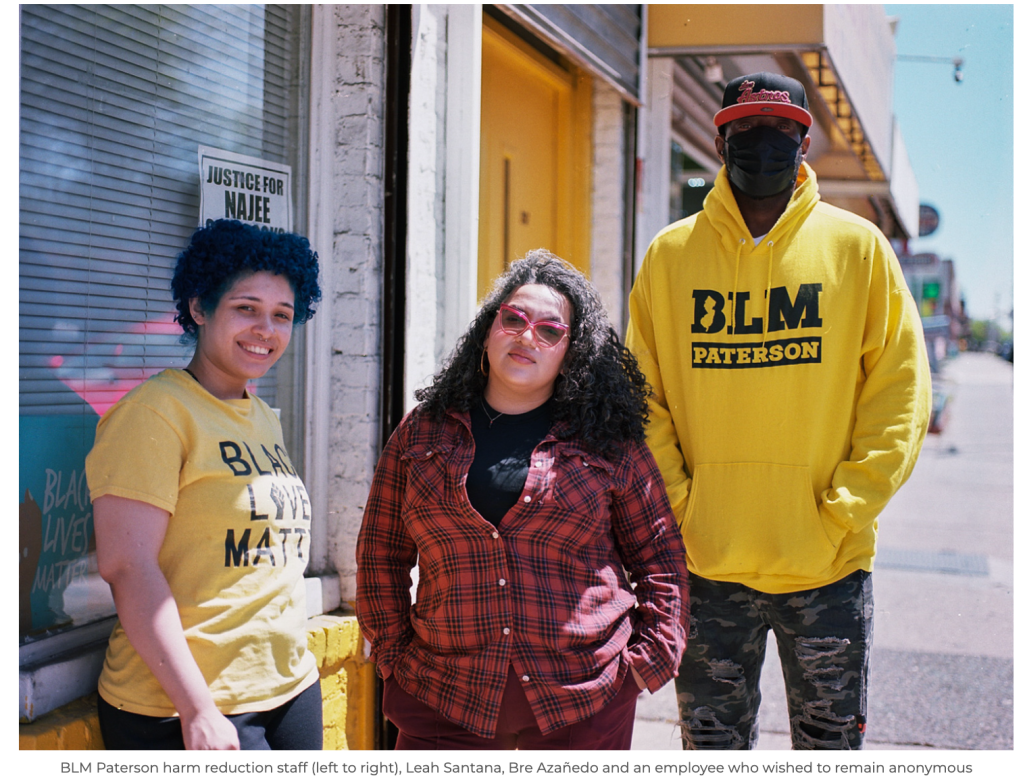
The Black Lives Matter movement began in 2013 as a response to police killings of Black Americans but has broadened to advocate for systemic racial justice and anti-racism.
Black Lives Matter Paterson has been working in the city since 2016 to facilitate racial equity and community building. Volunteers help carry out youth programs, mutual aid and advocacy.
At the height of the COVID-19 pandemic, the organization saw the need to distribute masks, food and other items to people in need. Eventually, that turned into distributing naloxone.
“And then we began doing our outreach [into the community]. Because we understood that a lot of times people don’t have the ability to come from certain areas, especially when you’re unhoused,” Azañedo said.
As the pandemic continued, BLM Paterson volunteers went out in the city where homeless people lived.
They taught those groups how to use naloxone and how to take care of wounds. That’s when the organization began to understand the need for harm-reduction work in the city.
“[We realized] now we need a place to be because in a lot of other spaces, you need to be sober in order to attend a lot of programs,” said Azañedo. “People are not allowed to just be.”
In early 2023, the organization opened its center on Broadway to be nearest to the people who needed it most.
On that cold and rainy day last March, Sue walked in and said one of the best parts of the center is that she can just be herself. She recalled how she was looking for some true-crime books — her favorite — at the library across the street when a member of the security staff there asked if she was OK.
“I was browsing the true-crime section and I turned around. This guy is just standing there and staring at me … like it’s just so strange for him to see somebody trying to read,” she said.
But when she comes into the center, she feels relaxed and not judged. The center helped her when she was pregnant last summer, she said. Having that support system was important, she said; it’s “everything you need in life.”
“Especially since my parents disowned me because of my addiction. And the one person that didn’t disown me, my sister, died. So to have really somebody there supporting you and accepting you and not judging you for the way you’re living and lifestyle means more than love,” Sue said.
The ‘war on drugs’
Much of the country’s drug policy and treatments have been informed by what was dubbed as the “war on drugs” in the 1980s and ’90s, a decades-long national approach that promoted punitive measures and abstinence to curb substance use. Harm reduction experts say that criminalization became another way to use systemic racism as a cudgel. This led to the overpolicing of communities like Paterson, a once-industrial hub of now 160,000, the third largest city in New Jersey. Six in 10 residents are Hispanic and another 1 in 5 are Black.
Zellie Thomas, who leads BLM Paterson, said the state and federal governments in all their policing efforts haven’t been investing in strategies that work in cities like Paterson, and that solutions to “addressing the opioid crisis … are very rarely presented or invested here in the city of Paterson.”
“The way that we got here in Paterson,” he said, referring to socioeconomic divestment in his city, “it wasn’t something that was just from one policy, or one bad politician. This is something that has been going on for decades.”
What the “war on drugs” did, and continues to do, is create a cycle of criminalization, said Ami Kachalia of ACLU New Jersey. And that cycle causes long-term trauma, she said, not just to the individuals, but to families and communities at large.
“While [the “war on drugs”] may have been done under the guise of public safety or public health, in practice it was really about criminalizing particular communities, particularly communities of color, low-income communities and other people that were really [pushing] for much-needed social change,” Kachalia said.
The numbers bear out across the nation, and New Jersey stands out.
According to New Jersey Policy Perspective, a social justice think tank, in a 2021 report, the state leads the country in racial disparities in incarceration and “incarcerated a higher percentage of people due to the drug war than any state in the nation by 1989.”
Jenna Mellor, head of the New Jersey Harm Reduction Coalition and author of the report, said she found that Black residents were “3.3 times more likely to be arrested for drug war violations than their white peers, despite white people both using and selling criminalized drugs at higher rates.” Black residents were also 12 times more likely to be incarcerated than their white counterparts.
“There was an inflection point in the late ’80s, early ’90s, where New Jersey policymakers — despite outcry from public health experts and community leaders — chose to aggressively punish and police people who use drugs,” said Mellor in an interview with NJ Spotlight News.
NJ’s approach
New Jersey has moved toward harm-reduction policies in recent years under the Murphy administration. During this time, naloxone has become more readily available — the state has provided over 600,000 naloxone doses to law enforcement and community groups.
In 2022, Murphy signed a law that allowed the state Department of Health to take control of authorizing needle exchange sites. Previously, municipalities could veto the sites, and only seven had signed on. Since then, the Health Department has increasingly authorized more harm-reduction centers across the state.
And in February, Murphy also announced initial plans for the $1 billion the state received in funds from settlement of the federal class-action lawsuits with opioid distributors and manufacturers to help mitigate the opioid crisis.
The plan was put together alongside harm reductionists like Mellor and Azañedo. In the next two years, the state will use $24 million of the funding to expand harm reduction services at centers and $17 million to invest in housing and shelter programs.
“We have more than doubled the number of harm reduction approved sites in the last year. We have now expanded decriminalization of supplies,” said state Health Commissioner Kaitlin Baston at a recent conference on harm reduction. “This means we can do drug checking and meeting people where they are, bringing them in for the support they need.”
Those who have advocated for the harm reduction strategies are taking note of the high-profile support, finally.
“There are so many people working right now to [expand harm reduction] and to try to make it successful, and make sure that our harm reduction expansion sticks to harm reduction’s roots,” Mellor said.
Back on Broadway
Winter has turned to spring, and that cold, blustery March day was far away. On a weekday in May, the sun baked the streets and Broadway was bustling.
Azañedo emerged from behind her desk and proudly said, “We’re now authorized by the state!”
The state’s approval of the BLM center to receive its funding was a several-month process, and she said the center will be able to now have a van to provide sterile syringes, collect used ones, and meet with people directly, wherever they are in Paterson.
The work won’t stop there. BLM Paterson would like to get a house where they can provide more wraparound services and meet participants’ other basic needs, like the ability to take a shower.
“Just a place where someone can come in and take a shower. That is so important. Because it makes you feel better,” said Azañedo. “Folks deserve that.”
 sistateacher